
HESS project results presented at EGU General Assembly 2026 in Vienna

From 3-8 May 2026, representatives of the HESS project participated in the EGU General Assembly 2026 in Vienna, one of the most important European scientific events dedicated to Earth sciences, environmental research, and energy transition. During the conference, Prof. Marcin Lutyński, and MSc Eng. Konrad Kołodziej, from the Silesian University of Technology, presented results obtained within the HESS project. Their presentations focused on the potential use of post-mining infrastructure, particularly mine shafts, as key components of future energy storage systems.
The first oral presentation, titled “Development of an Analytical Model and Computational Tool for Geomechanical Stability Assessment of Mine Shafts Adapted as Energy Storage Reservoirs”, was prepared by Konrad Kołodziej, Marcin Lutyński, and Grzegorz Smolnik. The presentation focused on the development of a mathematical model and computational tool, PRESS-SHAFT, for assessing the geomechanical stability of mine shafts adapted as energy storage reservoirs. The model considered, among other things, reverse stress conditions, high internal pressure, and thermal loads. Model verification showed that for shafts subjected to pressures up to 8 MPa, the critical area may not be the deepest part of the shaft, but the near-surface zone, where lower lithostatic stresses increase the risk of stability loss due to hydraulic fracturing.
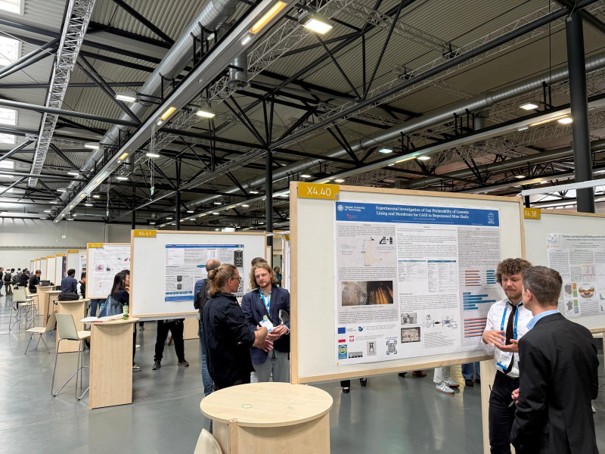 The second poster presentation, titled “Experimental Investigation of Gas Permeability of Concrete Lining and Membrane for CAES in Repurposed Mine Shafts,” was prepared by Marcin Lutyński and Konrad Kołodziej, from SUT. The poster presented the results of experimental research on the gas permeability of concrete shaft linings and sealing systems, which are important for the use of post-mining shafts in compressed air energy storage technology. The study involved C20/25 and C35/45 concrete samples, representing older and newer types of shaft lining, respectively, as well as two surface protection systems: a thin-film epoxy coating and a Xolutec membrane. The results showed that the coatings can reduce gas permeability by 3-4 orders of magnitude, which is crucial for reducing gas losses and improving the efficiency of energy storage.
The presented results align with the main objective of the HESS project, which is the development of a concept for a hybrid energy storage system based on post-mining infrastructure. The ongoing work covers geomechanical and material aspects, as well as issues related to sealing, safety, and the technical feasibility of adapting existing mine shafts for new functions within energy systems.
Participation in the EGU General Assembly 2026 enabled the presentation of HESS project results on an international forum and the exchange of experience with researchers working on energy transition, energy storage, post-mining infrastructure reuse, and geotechnical risk assessment. The EGU General Assembly 2026 was one of the largest scientific events in Europe, annually bringing together people from a broad range of geosciences. This year’s edition attracted 22,497 registered participants, including 20,027 in-person attendees in Vienna from 125 countries and 2,470 online attendees from 107 countries. The conference program included 20,173 presentations across 1,014 sessions, and 58% of the abstracts were submitted by Early Career Scientists.